Frances Larkham
of South Kingstown, Rhode Island

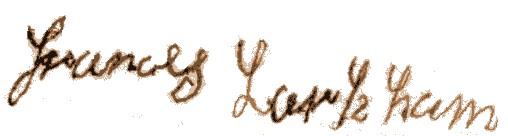
So little information survives concerning Frances Larkham that any discussion of her age, parentage, and origins must necessarily be speculative. Nevertheless, the surviving records provide enough evidence to reconstruct portions of her life and to place her within the social and economic landscape of mid-eighteenth-century South Kingstown and Richmond, Rhode Island
Frances is known with certainty to have been the mother of Lancelot Larkham,because that relationship is stated explicitly in the original apprenticeship indenture executed on 17 July 1749. The relationship is further confirmed by a sworn affidavit dated 13 June 1766 and recorded among the Richmond, Rhode Island probate records. In this statement, Lancelot acknowledged receiving from Margaret Enos, executrix, and Benjamin Enos, executor of the estate of Joseph Enos, the clothing owed to him under the terms of his apprenticeship. Referring to the original indenture, Lancelot stated that Joseph Enos had entered into an agreement with “my mother Francis Larkham” and had promised to provide him with a suit of apparel valued at twenty pounds old tenor upon completion of his term. This affidavit constitutes direct, first-person testimony by Lancelot himself, independently confirming both the apprenticeship arrangement and Frances Larkham's maternal relationship to him. Together, the affidavit and the original indenture firmly establish the mother-son connection.
Family records preserved by my great-grandmother identify Thomas Larkham as Lancelot's father. Combined with the fact that Frances bore the Larkham surname and no other Larkham family has been identified in Rhode Island during this period, the evidence strongly suggests that Frances was the wife of Thomas Larkham and the mother of Lancelot and, quite possibly, other children.
Frances's decision to place Lancelot into an apprenticeship in 1749 is consistent with the actions of a widowed mother. If she was indeed the wife of Thomas Larkham, she would have been left to raise her children following Thomas's death in 1746. In colonial Rhode Island, widowed women often relied upon apprenticeships to secure a trade for their sons while reducing the economic burden of supporting a child alone.

Thomas Larkham's Death and Frances's Circumstances
On 8 July 1746, Thomas Larkham enlisted in Captain Edward Cole's Company during the campaign against Canada, King George's War. The troops were quartered at Fort George on Goat Island in Newport Harbor, where they remained until 2 November 1746. Of 100 men listed on the muster roll of Captain Cole’s Company, twenty-five men died and twenty deserted.
Samuel Greene Arnold wrote in his History of the State of Rhode Island and Providence Plantations:
“These troops were quartered on Goat Island by July and from that time until November 2, when they finally sailed for Nova Scotia they were in a state of uncertainty as to their destination. . . .The number of desertions in the third roll is noticeably large. The fact that the pay of these men was recorded just as it was for those who stayed with the colors is evidence that the authorities knew of extenuating circumstances, or in some way looked leniently upon what is technically a serious fault.”
According to the muster roll of Captain Cole's company, Thomas Larkham died 4 September 1746, having served 58 days, wages due 1£ 6S. He apparently never left Fort George on Goat Island in Newport Harbor. Disease may have been among the "extenuating circumstances" to which Arnold referred.
Thomas's death in 1746 likely explains why it was Frances, rather than a father or guardian, who executed Lancelot's apprenticeship agreement three years later. At only eight and a half years of age, Lancelot was placed into the household of Joseph and Margaret Enos to learn the trade of weaving. Frances was almost certainly facing the economic realities of widowhood and single parenthood.
Woosted Corner and the Weaving Trade
The apprenticeship indenture identifies Frances as:
"Frances Larkham of South Kingstown in Kings County in the Colony of Rhode Island & Providence Plantation in New England Woosted Corner."
The phrase "Woosted Corner" appears to have been a local place-name. A 1718 Rhode Island land record also refers to an individual as being "of Woosted Corner," indicating that the name was already in use decades before Frances's appearance in the records.
The name itself strongly suggests a connection to "worsted," a type of woolen yarn and cloth. Although the precise location of Woosted Corner has not yet been identified, it may have been associated with textile production or a community in which weaving played an important economic role.
This possibility is reinforced by Frances's decision to apprentice her son to Joseph and Margaret Enos, both weavers. Her familiarity with the trade and her apparent ability to place Lancelot into an established weaving household suggest that she herself may have been connected to the textile economy of South Kingstown and Richmond.
The Apprenticeship and the Enos-Webster-Kenyon-Barber Network
Lancelot was apprenticed to Joseph and Margaret Enos of Richmond. The indenture was witnessed by Anna Kinyon and John Webster.
The individuals connected to the apprenticeship belonged to a tightly interwoven social network that linked many of the prominent families of Richmond and South Kingstown. In addition to Joseph and Margaret Enos, Richmond weavers, the indenture was witnessed by Anna Kinyon and John Webster. These four individuals were connected in several ways:
-
Marjorie Webster Schunke, in A Line of Descent from John Webster of Westerly, noted it is "possible that the Margaret Webster who married Joseph Enos in Westerly 20 Sep 1716" was a sister of John Webster (witness to the indenture). Genealogist Leo H. Garman, in The Wife or Wives of John Webster (?1692-1777/81) of Rhode Island, and the Webster-Kenyon Relationship also proposed that Margaret (Webster) Enos may have been a sister of John Webster of Westerly and Richmond. Garman based this conclusion on circumstantial evidence, noting that Margaret Webster's 1716 marriage to Joseph Enos occurred in the same place and timeframe as John Webster's marriage, suggesting that the two may have been siblings. While no direct evidence establishing the relationship has been found, the hypothesis is consistent with the close associations among the Enos, Webster, Kenyon, and Barber families that appear repeatedly in Richmond records.
-
Anna Kinyon, who also witnessed the indenture, was almost certainly Anna (Barber) Kinyon, wife of Sylvester Kinyon. There were several documents during the mid-1700s in which John Webster signed as witness along with either Anna Kinyon, Sylvester Kinyon, or both of them. In fact, on May 15, 1749, all three witnessed the will of John Enos.
-
John Webster's eldest daughter, Hannah Webster, married Ezekiel Barber, Anna (Barber) Kinyon's older brother.
-
John Webster's youngest daughter, Elizabeth Webster, married John Kenyon, son of Sylvester and Anna (Barber) Kenyon.
-
John Webster's youngest son, Thomas Webster, married on 17 November 1765, Patience Adams, born ca. 1745 in Richmond, daughter of John and Patience (Hall) Adams.
-
Lancelot Larkham married 1763, Prudence Adams, born 29 July 1741 in Richmond. I believe it's very likely that Prudence Adams was another daughter of John and Patience (Hall) Adams and a sister to Patience (Adams) Webster.
Collectively, these relationships demonstrate the close connections among the Enos, Webster, Kenyon, Barber, Adams, and Larkham families. While the appearance of John Webster and Anna Kinyon as witnesses may partly reflect their roles within the community, the decision by Frances to place Lancelot specifically with Joseph and Margaret Enos suggests a relationship of trust that may have arisen from family, neighborhood, occupational, church, or other longstanding social ties.
A Probable Daughter: Elizabeth Larkham
Frances and Thomas Larkham most likely had another child, a daughter Elizabeth, who was a few years younger than Lancelot.
In Dr. Joseph Torrey and His Record Book of Marriages, William Davis Miller transcribed the following entry from “A Record of the Names &c of the persons joyned together in Marriage by Joseph Torrey Pastor of the Chts: of Christ in South Kingstown":
“William Rees & Elizabeth Larkham both of this Town were Lawfully Married Aug. 16, 1767.”
Given the rarity of the Larkham surname in eighteenth-century Rhode Island, the South Kingstown location, and the timing of the marriage, only a few years after Lancelot's own marriage, it is highly likely that Elizabeth Larkham was a younger sister of Lancelot and another child of Frances and Thomas Larkham.
If this identification is correct, Frances and Thomas had at least two children: Lancelot and Elizabeth.
Frances's Last Known Record
In 1751, Frances Larkham received £1 from the estate of William Robinson (South Kingstown Town Council records, Volume 4, p. 370, Film # 093184). William Robinson was one of South Kingstown's largest landowners. Although the reason for the payment is not stated, it indicates that Frances participated in the local economy and maintained recognized dealings with the Robinson estate. Given her apparent connections to the weaving trade and the absence of any record showing her as a recipient of poor relief, the payment may represent wages or compensation for services rendered. The record further supports the conclusion that Frances remained an active member of the South Kingstown community following the death of Thomas Larkham.
South Kingstown and Richmond, Rhode Island town council records have plenty of instances in which widows were ordered to place their children into apprenticeships to avoid their becoming chargeable to the town. Frances Larkham is not named in any records, indicating that she on her own, or with assistance from family placed Lancelot into an apprenticeship with Joseph and Margaret Enos. If Frances was not orginally from South Kingstown, she would likely have been warned out of town to avoid becoming chargeable to the town or listed among the town poor, however no mention of her is made in town records, other than the 1£ she was paid from William Robinson's estate, which may indicate she worked on Robinson's estate. It is possible she was from a South Kingstown family, and in addition to bringing in her own wages, she had some level of support from a local family.
The Possibility That Frances Lived with Lancelot
The 1774 Rhode Island census records Lancelot's household as containing:
|
|
|
Family records and Richmond vital records establish that all of Lancelot and Prudence's daughters were under sixteen in 1774. Elizabeth Larkham had married William Rees in 1767 and was presumably living elsewhere. Consequently, the additional adult female cannot be explained by any known daughter of the household.
It is therefore possible that the unidentified woman was Frances Larkham, residing with her son and daughter-in-law during her later years. While the census does not identify relationships among household members, this interpretation is consistent with the common eighteenth-century practice of elderly widowed mothers living with adult children.
Possible Origins of Frances Larkham
No surviving record identifies Frances Larkham's maiden name or parentage. Nevertheless, the available evidence suggests that she was not an outsider to the South Kingstown-Richmond community, but rather a woman deeply rooted in the interconnected network of families who dominated the area's social and economic life during the first half of the eighteenth century.
Following the death of Thomas Larkham in 1746, Frances placed her young son, Lancelot, as an apprentice with Joseph and Margaret Enos, respected weavers of Richmond. The choice of the Enos household was likely not accidental. Apprenticeships involving young children were commonly arranged through trusted family, neighborhood, church, or occupational relationships. Lancelot's later affidavit concerning the apprenticeship demonstrates that the connection between the Larkham and Enos families continued for many years after the original agreement.
The Enos family was closely associated with the Webster, Kenyon, and Barber families through marriage, neighborhood ties, and community affairs. Although the witnesses to Lancelot's apprenticeship also appear together on other contemporary Richmond documents, suggesting that they may have served important community functions, the circumstances surrounding the apprenticeship nevertheless place Frances within the orbit of this interconnected group.
While no direct evidence has yet been found linking Frances by blood to any particular family, her residence at Woosted Corner, her apparent familiarity with the weaving trade, her successful avoidance of poor-relief proceedings, and her ability to place Lancelot within an established weaving household all suggest that she was a local woman supported by longstanding family and community relationships.
All things considered, the evidence portrays Frances as a woman of local roots, probably born between 1705 and 1715, whose family was likely connected to the weaving and farming communities of South Kingstown and Richmond. Although her exact parentage remains unknown, she appears to have been a member of the same closely intertwined Rhode Island community that shaped the lives of the Enos, Webster, Kenyon, Barber, and Adams families for generations.
Sources
Bartlett, John R. Census of the State of Rhode Island 1774. Providence, RI, USA: Knowles, Anthony & Co., State Printers, 1858.
Indenture for the Apprenticeship of Lancelot Larkham of South Kingstown, Rhode Island to the Weavers Joseph and Margaret Enoss of Richmond, Rhode Island, July 7, 1749 (original document in the possession of Sally Russell Cox)
International Genealogical Index parish register extraction listings from the LDS Church's Family Search Internet Genealogy Service at http://www.familysearch.org/Search/searchigi.asp
The records of Sarah Clark Burdick
Rhode Island in the Colonial Wars by Howard M. Chapin, p. 22
South Kingstown, Rhode Island Land Evidence Records, pp. 275-277 (LDS Family History Library Microfilm # 0931301)
South Kingstown, Rhode Island Town Council Records (LDS Family History Library Microfilms # 0931833 and # 0931834)
| Larkham Ancestor Webpages |
|
The Larkham Family of Rhode Island and Connecticut |
|
Carrie Estelle Larkham of Canterbury, Connecticut |
|
William H. Larkham of Voluntown and Canterbury, Connecticut |
|
Lot Larkham of Voluntown, Connecticut |
|
Lancelot Larkham of Richmond, Rhode Island and Voluntown, CT. |
|
Frances Larkham of South Kingstown, Rhode Island |
|
Thomas Larkham of South Kingstown, Rhode Island |
Sally' s Website Genealogy Home My New England Ancestry My Asia Minor and Pontic Greek Ancestry Contact Me
The background paper for this page is from Ender Design's Realm Graphics collection.
The pinecone graphics on this page is are scans of stencils I made using the stencil,
Pansy Flower Wall Stencil Border, produced by Designer Stencils.
Last updated: Monday, June 22, 2026 09:03:41 AM